No Results Found
The page you requested could not be found. Try refining your search, or use the navigation above to locate the post.


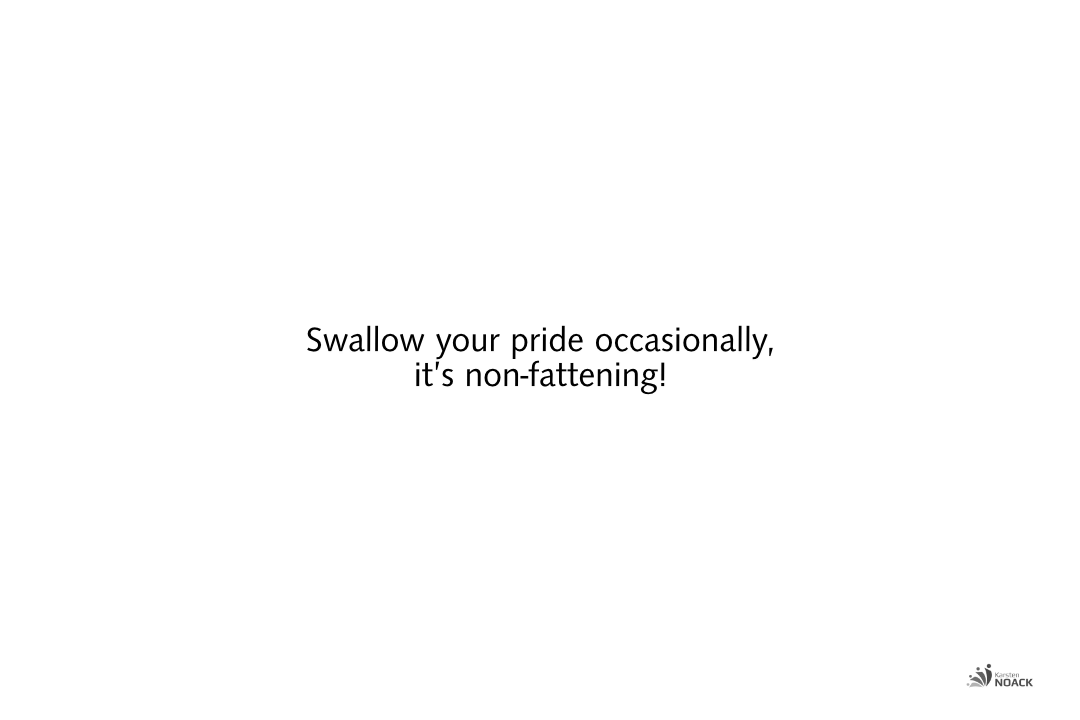
Is it necessary to insist on being right all the time?
I select the motto of the day mostly because something about it appeals to me. Something attracts me or irritates me. It feels as if it could contain something and I want to get to the root of it. So I dedicate a motto to each day and let myself be surprised what it has to offer me.
Sometimes the reason for the choice clarifies itself only after a while. That's why the thoughts about the motto of the day are often not articles, but associations. They are thoughts transformed into words. They are spontaneous and I also publish them frequently while I am traveling. They, therefore, tend to appear in fragments. Feel invited to add your associations in the comments. Enrich the thoughts with your perspectives – to complete the picture.
Ask yourself constructive questions like the following and you will personally benefit from each motto of the day:
And what can I do if I disagree with a motto? There is often something personal to learn from quotations with which we disagree. Helpful questions in such a case are:
If you have specific questions or want to know more about how I can help, just ask me directly. For questions that might interest others, please feel free to post them in the comments section below.
If you're interested in coaching, training, or consulting, have organizational questions, or would like to schedule an appointment, the best way to reach me is through this contact form (where you can choose whether to provide your personal data) or by email at mail@karstennoack.com. You can find the privacy policy here.
Transparency is important to me. To help you get started, I've provided answers to frequently asked questions about myself (profile), the services I offer, fees, and the process of getting to know me. If you like what you see, I'd be delighted to work with you.
This article is a short excerpt from the more comprehensive course materials my clients receive in a group or individual training or coaching.
Published: December 9, 2019
Author: Karsten Noack
Revision: December 10, 2019
Translation: ./.
German version:
K:
H:
T:
#234

Those who already know everything, don’t want to and will learn nothing more. What exactly is healthy doubt, and how can we foster it?
Some people have accumulated so many hunches and opinions that there is no more space for learning.
And before someone gets the impression that I am throwing stones around me while sitting in a glasshouse; nobody is really free of that. It is not always so easy to know what to doubt.
I think it is important to question even holy cows with healthy doubt from time to time. Although it is not so clearly defined what healthy doubt is.
Too many doubts and especially self-doubt easily lead to problems. This binds too much energy and it paralyzes.
On the other hand, especially personalities who know themselves and rest in themselves are able to doubt things constructively. “He who believes to be something has stopped becoming something”, Socrates said. Yes, then there is no more personal development.
And so the question remains for me; what exactly is healthy doubt, and how can I foster it?
I select the motto of the day mostly because something about it appeals to me. Something attracts me or irritates me. It feels as if it could contain something and I want to get to the root of it. So I dedicate a motto to each day and let myself be surprised what it has to offer me.
Sometimes the reason for the choice clarifies itself only after a while. That's why the thoughts about the motto of the day are often not articles, but associations. They are thoughts transformed into words. They are spontaneous and I also publish them frequently while I am traveling. They, therefore, tend to appear in fragments. Feel invited to add your associations in the comments. Enrich the thoughts with your perspectives – to complete the picture.
Ask yourself constructive questions like the following and you will personally benefit from each motto of the day:
And what can I do if I disagree with a motto? There is often something personal to learn from quotations with which we disagree. Helpful questions in such a case are:
If you have specific questions or want to know more about how I can help, just ask me directly. For questions that might interest others, please feel free to post them in the comments section below.
If you're interested in coaching, training, or consulting, have organizational questions, or would like to schedule an appointment, the best way to reach me is through this contact form (where you can choose whether to provide your personal data) or by email at mail@karstennoack.com. You can find the privacy policy here.
Transparency is important to me. To help you get started, I've provided answers to frequently asked questions about myself (profile), the services I offer, fees, and the process of getting to know me. If you like what you see, I'd be delighted to work with you.
This article is a short excerpt from the more comprehensive course materials my clients receive in a group or individual training or coaching.
Published: May 10, 2020
Author: Karsten Noack
Revision: May 10, 2020
Translation: ./.
German version:
K:
H:
T: RR
#656
Out with the old, in with the new: may you be happy the whole year through.
A new year is like a blank 365-page book, and the pen is in your hands.
It is your chance to write a beautiful story for yourself.
Happy New Year.
I select the motto of the day mostly because something about it appeals to me. Something attracts me or irritates me. It feels as if it could contain something and I want to get to the root of it. So I dedicate a motto to each day and let myself be surprised what it has to offer me.
Sometimes the reason for the choice clarifies itself only after a while. That's why the thoughts about the motto of the day are often not articles, but associations. They are thoughts transformed into words. They are spontaneous and I also publish them frequently while I am traveling. They, therefore, tend to appear in fragments. Feel invited to add your associations in the comments. Enrich the thoughts with your perspectives – to complete the picture.
Ask yourself constructive questions like the following and you will personally benefit from each motto of the day:
And what can I do if I disagree with a motto? There is often something personal to learn from quotations with which we disagree. Helpful questions in such a case are:
This article is a short excerpt from the more comprehensive course materials my clients receive in a group or individual training or coaching.
Published: January 1, 2006
Author: Karsten Noack
Revision: November 19th, 2024
Translation: ./.
German version:
K:
H:
T: RR
#165
How important is knowledge about language and synonyms?
Synonyms are words with the same or similar meanings.
What comes to my mind when thinking about this motto of the day? Hmm. I enjoy playing around with words. Language is interesting. The more flexible I am with words, the better I can choose those words that express best what I want to say.
Synonyms are useful in three ways: They bring variety, conciseness, and originality to messages.
Often I am concerned with finding a more appropriate term for what I want to express. There are many reasons why a certain word is not quite appropriate. Perhaps it is too imprecise, too spongy.
Repetitions are not always bad; you risk using synonyms to take the edge off messages, bring in ambiguities or change the meaning.
Watch it! Don’t try desperately to be funny. You need a feeling for language.
I select the motto of the day mostly because something about it appeals to me. Something attracts me or irritates me. It feels as if it could contain something and I want to get to the root of it. So I dedicate a motto to each day and let myself be surprised what it has to offer me.
Sometimes the reason for the choice clarifies itself only after a while. That's why the thoughts about the motto of the day are often not articles, but associations. They are thoughts transformed into words. They are spontaneous and I also publish them frequently while I am traveling. They, therefore, tend to appear in fragments. Feel invited to add your associations in the comments. Enrich the thoughts with your perspectives – to complete the picture.
Ask yourself constructive questions like the following and you will personally benefit from each motto of the day:
And what can I do if I disagree with a motto? There is often something personal to learn from quotations with which we disagree. Helpful questions in such a case are:
If you have specific questions or want to know more about how I can help, just ask me directly. For questions that might interest others, please feel free to post them in the comments section below.
If you're interested in coaching, training, or consulting, have organizational questions, or would like to schedule an appointment, the best way to reach me is through this contact form (where you can choose whether to provide your personal data) or by email at mail@karstennoack.com. You can find the privacy policy here.
Transparency is important to me. To help you get started, I've provided answers to frequently asked questions about myself (profile), the services I offer, fees, and the process of getting to know me. If you like what you see, I'd be delighted to work with you.
This article is a short excerpt from the more comprehensive course materials my clients receive in a group or individual training or coaching.
Published: December 9, 2019
Author: Karsten Noack
Revision: December 10, 2019
Translation: ./.
German version:
K:
H:
T:
#234
The soul is the part of a living being that consists of the mind, character, thoughts, and feelings. It is the spiritual part of a person that some people believe continues to exist in some form after their body has died.
Humans are born with a soul. This is claimed and few deny it. But, who has seen it, the soul? What we notice from the outside is how a person behaves. We suspect what he is inspired by.
“And what do you benefit if you gain the whole world but lose your soul? What will people give in exchange for their lives?,” said the carpenter from Bethlehem.
Whenever we fall short of our professed moral norms, we sell a little bit of our soul. A deal with the devil is a cultural motif, best exemplified by the legend of Faust and the figure of Mephistopheles. He is essentially a tragic figure who makes a morally wrong choice. Are we are more clever today? What do you mean?
I select the motto of the day mostly because something about it appeals to me. Something attracts me or irritates me. It feels as if it could contain something and I want to get to the root of it. So I dedicate a motto to each day and let myself be surprised what it has to offer me.
Sometimes the reason for the choice clarifies itself only after a while. That's why the thoughts about the motto of the day are often not articles, but associations. They are thoughts transformed into words. They are spontaneous and I also publish them frequently while I am traveling. They, therefore, tend to appear in fragments. Feel invited to add your associations in the comments. Enrich the thoughts with your perspectives – to complete the picture.
Ask yourself constructive questions like the following and you will personally benefit from each motto of the day:
And what can I do if I disagree with a motto? There is often something personal to learn from quotations with which we disagree. Helpful questions in such a case are:
If you have specific questions or want to know more about how I can help, just ask me directly. For questions that might interest others, please feel free to post them in the comments section below.
If you're interested in coaching, training, or consulting, have organizational questions, or would like to schedule an appointment, the best way to reach me is through this contact form (where you can choose whether to provide your personal data) or by email at mail@karstennoack.com. You can find the privacy policy here.
Transparency is important to me. To help you get started, I've provided answers to frequently asked questions about myself (profile), the services I offer, fees, and the process of getting to know me. If you like what you see, I'd be delighted to work with you.
This article is a short excerpt from the more comprehensive course materials my clients receive in a group or individual training or coaching.
Published: November 2, 2010
Author: Karsten Noack
Revision: August 14, 2019
Translation: ./.
German version:
K:
T: RR
#1872
Today I share with you:
What we should do as individuals is to use the power of democracy to make our voices heard and to make sure that the people in power cannot continue to ignore this.
Climate activist Greta Thunberg
What are you waiting for? You don’t have to be a Jedi to make a difference. It doesn’t take Midi-Chlorians to stand up for the world. In the words of George Bernhard Shaw, “The best reformers the world has ever seen are those who commence on themselves.”
Some people wrongly confuse naggers and do-gooders. Naggers are dissatisfied victims who feel exposed to the circumstances. Do-gooders see injustice and potential. They are prepared to commit themselves, to shape, to act. Where others are still discussing the question of guilt, a do-gooder is already turning the wheel and moving things for the better. Many of them prefer to forego public attention unless it serves the set task.
Together with other experts, I support do-gooders also honorary. You find information in the article Are you a do-gooder? Make the world a better place.
I select the motto of the day mostly because something about it appeals to me. Something attracts me or irritates me. It feels as if it could contain something and I want to get to the root of it. So I dedicate a motto to each day and let myself be surprised what it has to offer me.
Sometimes the reason for the choice clarifies itself only after a while. That's why the thoughts about the motto of the day are often not articles, but associations. They are thoughts transformed into words. They are spontaneous and I also publish them frequently while I am traveling. They, therefore, tend to appear in fragments. Feel invited to add your associations in the comments. Enrich the thoughts with your perspectives – to complete the picture.
Ask yourself constructive questions like the following and you will personally benefit from each motto of the day:
And what can I do if I disagree with a motto? There is often something personal to learn from quotations with which we disagree. Helpful questions in such a case are:
If you have specific questions or want to know more about how I can help, just ask me directly. For questions that might interest others, please feel free to post them in the comments section below.
If you're interested in coaching, training, or consulting, have organizational questions, or would like to schedule an appointment, the best way to reach me is through this contact form (where you can choose whether to provide your personal data) or by email at mail@karstennoack.com. You can find the privacy policy here.
Transparency is important to me. To help you get started, I've provided answers to frequently asked questions about myself (profile), the services I offer, fees, and the process of getting to know me. If you like what you see, I'd be delighted to work with you.
This article is a short excerpt from the more comprehensive course materials my clients receive in a group or individual training or coaching.
Published: March 2, 2007
Author: Karsten Noack
Revision: November 19th, 2024
Translation: ./.
German version: https://www.karstennoack.de/weltverbesserer-coaching/
K:
H:
T: RR
#121
Today I share with you:
A pause, if used correctly, can add a great deal to your speech. Powerful and persuasive presenters recognize the importance of the pause. Pausing a speech will create a moment, drive home a message and connect with an audience.
Your message is not simply conveyed by your words, but also by your pauses. In speaking, the drama and power of the speech are contained in the silences that you create as you move from one element to another. This is a skill that you can learn to master with practice. A pause isn’t a moment of nothing. Used strategically, it is a tool to help you build an intellectual and emotional connection with your audience. When you pause, you give your audience time to process what you have just said.
When most people get up to speak they tend to talk from the moment they are introduced till they sit down. Most speakers ignore that the pauses in their talk can get a lot of attention.
When you want to impress your audience to use the power of pauses. Next time you’re speaking just take an extra-long pause and observe what happens. In case you choose the right moment and your body language is good, there is a high chance that everyone looks up and starts paying more attention to you and your message.
The quote “No word was ever as effective as a rightly timed pause”. is from Mark Twain’s Speeches, 1923. Seems he was interested in the power of pauses because he wrote in Autobiographical dictation, 11 October 1907:
That impressive silence, that eloquent silence, that geometrically progressive silence which often achieves a desired effect where no combination of words howsoever felicitous could accomplish it…. For one audience, the pause will be short; for another a little longer; for another a shade longer still; the performer must vary the length of the pause to suit the shades of difference between audiences. … I used to play with the pause as other children play with a toy.
Those who do not speak are not heard, and even those who do speak are not always successful. True success in communication requires mastering a few additional, critical steps to ensure your message resonates.
Do you want your message to be convincing and your personality to shine? I can help you prepare your speeches and presentations to achieve exactly that. Whether you need comprehensive guidance or just a few tweaks, you decide the level of support that fits your needs. At a minimum, I recommend a test run with professional feedback to fine-tune both your delivery and your content. This helps you understand how you and your message are perceived, identify what works well, and determine areas for improvement.
Why wait until after your real performance to receive valuable feedback, when it's too late to adjust? Early preparation is key. As the saying goes: 'Luck is what happens when preparation meets opportunity.' With thorough preparation, you will not only feel more confident but will also be well-equipped to make a lasting impact.
You can decide where the effort is most worthwhile, based on the expected benefits. I offer support covering all areas of effective communication, including psychology, language, structure, voice, body language, storytelling, rhetorical techniques, and the use of media like PowerPoint. My goal is to help you deliver a well-rounded, impactful presentation.
Not in Berlin? No problem. We can meet via telephone or video call. Of course, visiting Berlin can also be an enriching experience, and I am happy to welcome you here.
Many people struggle with intense stage fright, which can cause their performance to fall short of its true potential. With my guidance, you can overcome these challenges and deliver your best possible performance. Together, we'll turn anxiety into confidence, ensuring that your message and personality shine through.
How effective are you in your speeches and presentations? Are your skills strong in the 111+ essential areas of impactful presenting?
Since 1998, I have analyzed countless speeches and presentations. This extensive experience—including learning from my own mistakes—has given me a deep understanding of what works for different audiences.
Get the feedback you need to excel. With my help, you will receive actionable recommendations and insights that will allow you to connect with your audience and deliver your message effectively, regardless of the context.
Interested? Here’s how you can receive valuable feedback to enhance your speeches and presentations.
If you have specific questions or want to know more about how I can help, just ask me directly. For questions that might interest others, please feel free to post them in the comments section below.
If you're interested in coaching, training, or consulting, have organizational questions, or would like to schedule an appointment, the best way to reach me is through this contact form (where you can choose whether to provide your personal data) or by email at mail@karstennoack.com. You can find the privacy policy here.
Transparency is important to me. To help you get started, I've provided answers to frequently asked questions about myself (profile), the services I offer, fees, and the process of getting to know me. If you like what you see, I'd be delighted to work with you.
I select the motto of the day mostly because something about it appeals to me. Something attracts me or irritates me. It feels as if it could contain something and I want to get to the root of it. So I dedicate a motto to each day and let myself be surprised what it has to offer me.
Sometimes the reason for the choice clarifies itself only after a while. That's why the thoughts about the motto of the day are often not articles, but associations. They are thoughts transformed into words. They are spontaneous and I also publish them frequently while I am traveling. They, therefore, tend to appear in fragments. Feel invited to add your associations in the comments. Enrich the thoughts with your perspectives – to complete the picture.
Ask yourself constructive questions like the following and you will personally benefit from each motto of the day:
And what can I do if I disagree with a motto? There is often something personal to learn from quotations with which we disagree. Helpful questions in such a case are:
This article is a short excerpt from the more comprehensive course materials my clients receive in a group or individual training or coaching.
Published: March 1, 2009
Author: Karsten Noack
Revision: November 19th, 2024
Translation: ./.
German version:
K:
H:
T: RR
#945
Humbleness or humility is perhaps an under-rated virtue. Why does humility matter?
Like gentleness, humility is often an underrated character trait. It’s a strength, in my opinion, because it brings many benefits.
Humility means having a modest opinion of one’s importance or work. But it’s so much more than that. Humble people value relationships at eye level, cooperation, harmony, fairness, are open to experience. They value the uniqueness and value of different people. They are convinced that every person is something special without being superior to others. It is the belief that every person has something to contribute that makes them ready to look at themselves and their fellow human beings in a more relaxed way. They have a balanced awareness of their limitations and those of others. But they also cultivate the perception of unique talents and strengths. They can remain grounded and bring thought, achievement, and experience into a balanced perspective. This makes one’s ego more constructive. This is powerful, as the ego can blind people to what they do, and do not know.
Humble people are more resistant to stress, have better social relationships, better subjective well-being, better physical and mental health. Humble people are more generous and helpful, are perceived as friendlier, liked by others, and less threatening. Such people are often better embedded in society, social networks, and organizations.
Here are some benefits:
I select the motto of the day mostly because something about it appeals to me. Something attracts me or irritates me. It feels as if it could contain something and I want to get to the root of it. So I dedicate a motto to each day and let myself be surprised what it has to offer me.
Sometimes the reason for the choice clarifies itself only after a while. That's why the thoughts about the motto of the day are often not articles, but associations. They are thoughts transformed into words. They are spontaneous and I also publish them frequently while I am traveling. They, therefore, tend to appear in fragments. Feel invited to add your associations in the comments. Enrich the thoughts with your perspectives – to complete the picture.
Ask yourself constructive questions like the following and you will personally benefit from each motto of the day:
And what can I do if I disagree with a motto? There is often something personal to learn from quotations with which we disagree. Helpful questions in such a case are:
If you have specific questions or want to know more about how I can help, just ask me directly. For questions that might interest others, please feel free to post them in the comments section below.
If you're interested in coaching, training, or consulting, have organizational questions, or would like to schedule an appointment, the best way to reach me is through this contact form (where you can choose whether to provide your personal data) or by email at mail@karstennoack.com. You can find the privacy policy here.
Transparency is important to me. To help you get started, I've provided answers to frequently asked questions about myself (profile), the services I offer, fees, and the process of getting to know me. If you like what you see, I'd be delighted to work with you.
This article is a short excerpt from the more comprehensive course materials my clients receive in a group or individual training or coaching.
Published: March 5, 2007
Author: Karsten Noack
Revision: November 19th, 2024
Translation: ./.
German version: https://www.karstennoack.de/demut-ist-unverwundbarkeit-marie-von-ebner-eschenbach/
K:
H:
T: RR
#1890
Values sound simple.
Integrity.
Respect.
Freedom.
Loyalty.
Responsibility.
Courage.
Fairness.
Success.
Security.
Yet values become truly interesting when they begin to compete with each other.
And even more when living by them has a price.
It is easy to value honesty when honesty is convenient.
Courage matters when speaking up has consequences.
Respect matters when you strongly disagree.
Integrity matters when compromising it would make life easier.
Values become visible through decisions.
Values are principles that help you judge what matters.
They influence:
what you pursue,
what you avoid,
what you tolerate,
what you protect,
what you admire,
and what you are willing to stand for.
Values help create orientation.
They can act like a compass.
A compass does not tell you exactly which road to take.
It tells you which direction matters.
That distinction is important.
Many people can name a few values immediately.
Respect.
Freedom.
Family.
Integrity.
Success.
That is a useful beginning.
Yet the real question is:
What does this value mean in practice?
What does respect look like when you strongly disagree?
What does loyalty mean when someone behaves badly?
What does integrity mean when telling the truth is uncomfortable?
What does freedom mean when security would be easier?
A value becomes clearer through behavior.
Imagine someone says:
“Integrity is one of my most important values.”
That sounds good.
Then a situation appears where telling the truth may cost money, status, approval, or opportunity.
Now the value becomes real.
The same applies to courage.
Courage is rarely required when everything feels safe.
Loyalty becomes interesting when loyalty creates tension.
Fairness becomes visible when you could benefit from being unfair.
Values are easiest to admire in theory.
Their meaning appears in practice.
Important decisions are rarely difficult because we lack intelligence.
Often, several options make sense.
Different interests pull in different directions.
Information is incomplete.
And each choice carries consequences.
Values help create priorities.
Ask:
What matters most here?
What would I regret compromising?
Which option fits the kind of person or leader I want to be?
Which decision can I still respect afterwards?
These questions often reveal something that a purely analytical comparison misses.
Values are useful.
They are not a shortcut around analysis.
A decision may involve:
facts,
risks,
financial consequences,
legal obligations,
responsibilities,
timing,
interests,
and uncertainty.
Values belong in that picture.
They do not replace it.
The best decisions often bring together:
facts, experience, consequences, responsibility, and values.
This is where things become especially interesting.
Many difficult decisions are not a conflict between a value and something unimportant.
They are a conflict between two important values.
For example:
Loyalty versus honesty.
Security versus freedom.
Harmony versus clarity.
Growth versus stability.
Compassion versus accountability.
Privacy versus transparency.
Speed versus thoroughness.
Sometimes both sides deserve respect.
The task is not to discover which value is good and which is bad.
The task is to decide:
Which value deserves priority in this situation?
When a decision feels strangely difficult, ask:
Which values are competing here?
That question can create immediate clarity.
Perhaps the decision is not:
“Should I say something?”
Perhaps it is:
“Do I prioritize harmony or honesty?”
Perhaps the question is not:
“Should I accept the offer?”
Perhaps it is:
“Do I prioritize security or development?”
Naming the conflict makes the decision more understandable.
Respect is a particularly interesting value.
Some people confuse respect with agreement.
Others confuse it with silence.
They are different things.
You can disagree respectfully.
You can challenge an idea without attacking the person.
You can question authority without becoming disrespectful.
You can say no while remaining professional.
You can set a boundary without humiliating someone.
Sometimes silence is respectful.
Sometimes speaking up is the more respectful choice.
The useful question is:
What form of respect does this situation require?
Speaking clearly does not require aggression.
Courage does not require drama.
Sometimes courage looks like:
asking the uncomfortable question,
addressing the obvious problem,
saying that you disagree,
setting a boundary,
admitting uncertainty,
or refusing to support something you consider wrong.
Respect shapes the way you do it.
Courage shapes whether you do it at all.
Both can belong together.
Leadership makes values visible.
Especially when circumstances become difficult.
When performance drops.
When pressure rises.
When someone makes a mistake.
When a popular employee behaves badly.
When a decision has unpleasant consequences.
When senior management expects something you question.
When an organization claims to value something that suddenly becomes expensive.
A company can write fifteen values on a wall.
The more interesting question is:
What happens when one of those values costs money?
That is where culture becomes visible.
Your professional reputation is influenced by more than results.
People observe:
how you treat others,
how you respond under pressure,
whether your words and actions fit together,
whether you keep agreements,
whether you take responsibility,
and what happens when doing the right thing becomes inconvenient.
Consistency creates trust.
Perfection is unnecessary.
People can forgive mistakes.
They struggle more with repeated contradictions between what someone claims to value and how that person behaves.
Values become highly relevant in communication.
Perhaps you value harmony.
That can support cooperation.
It can also make difficult conversations easier to postpone.
Perhaps you value clarity.
That can strengthen leadership.
It can also become harshness if empathy disappears.
Values rarely need to disappear.
They often need balance.
Ask:
How can I express this value in a way that serves the situation?
Negotiations involve interests.
They also involve values.
What are you willing to compromise?
What is a preference?
What is a principle?
Where do you have flexibility?
Where does compromise become self-betrayal?
Clear answers help prevent two common mistakes.
Giving away too much because you never clarified what matters.
Or becoming rigid because every preference feels like a principle.
Know the difference.
Boundaries are often connected to values.
Respect.
Fairness.
Time.
Health.
Professional standards.
Responsibility.
A boundary becomes easier to communicate when you understand what it protects.
Instead of:
“I just don’t want this.”
you may realize:
“This boundary protects quality.”
or:
“This protects my responsibility toward the team.”
Clarity about the underlying value strengthens the boundary.
Values also shape professional identity.
What kind of leader do you want to be?
What kind of colleague?
What kind of entrepreneur?
What kind of professional?
These questions matter especially during transitions.
A new role can create pressure to behave in ways that feel foreign.
Greater visibility can invite imitation.
More responsibility can create distance from what once felt clear.
Values help create continuity during change.
Some values are truly ours.
Others are inherited.
Family expectations.
Corporate culture.
Professional norms.
Social expectations.
Ideas about success.
Status.
Prestige.
At some point, it is useful to ask:
Do I actually value this?
Or:
Have I simply learned that I should?
That distinction can change decisions significantly.
Values can evolve.
Responsibility changes us.
Experience changes us.
Loss changes us.
Success changes us.
Age changes us.
What mattered most at 25 may look different at 45.
That does not mean the earlier value was wrong.
It means people develop.
Revisit your values occasionally.
Especially when your life or professional role changes.
When facing a difficult decision, use these four questions.
Which values are involved?
Be specific.
Instead of saying:
“Integrity.”
ask:
“What does integrity require in this situation?”
Is this:
loyalty versus honesty?
security versus growth?
harmony versus clarity?
speed versus quality?
individual freedom versus responsibility?
Naming the conflict often reduces confusion.
Every serious decision has a price.
What do you gain?
What do you lose?
What do you protect?
What do you compromise?
What consequence could you live with?
What consequence would be difficult to respect afterwards?
Imagine looking back in one year.
Or five years.
Which decision would you still understand?
Which one would fit the person you want to be?
This question creates distance from immediate pressure.
Pressure makes values harder to access.
Urgency narrows attention.
Fear emphasizes short-term consequences.
Status can influence judgment.
Group dynamics can silence disagreement.
This is one reason important decisions deserve enough space.
When possible, avoid letting the loudest pressure become the strongest value.
Ask:
What matters after the pressure has passed?
This question receives too little attention.
We often ask whether values survive adversity.
Success can test them too.
Power.
Status.
Money.
Visibility.
Influence.
Admiration.
These can quietly change behavior.
Ask:
Do I still listen?
Do I still accept criticism?
Do I still treat people with respect when I no longer need anything from them?
Do I still keep promises when breaking them would be profitable?
Values matter on the way up too.
Fear can create another test.
People may become:
more cautious,
more agreeable,
more controlling,
more avoidant,
or more defensive.
That is human.
The useful question is:
Which value do I want access to when fear is present?
Perhaps courage.
Clarity.
Fairness.
Responsibility.
That value can become an anchor.
Integrity is often described as doing the right thing when nobody is watching.
That is useful.
I would add something else:
Integrity is also the willingness to notice when your behavior no longer fits what you say matters.
That requires self-correction.
Integrity without reflection can become self-righteousness.
Real integrity includes the ability to say:
“I need to reconsider this.”
Compromise is neither automatically good nor automatically weak.
Some situations require flexibility.
Others require a clear line.
A useful distinction is:
Am I compromising a preference or a principle?
Preferences can often move.
Principles deserve more attention.
Confusing the two creates either unnecessary rigidity or excessive accommodation.
The term “non-negotiable” is frequently overused.
If everything is non-negotiable, negotiation becomes impossible.
Choose carefully.
What genuinely deserves that status?
Professional ethics?
Legal obligations?
Safety?
Respect?
A core responsibility?
Clarity about real non-negotiables creates more flexibility around everything else.
Living according to values can have consequences.
You may lose approval.
An opportunity.
A relationship.
Money.
Status.
Convenience.
That deserves acknowledgment.
Values are neither magic nor protection from consequences.
They help answer a different question:
Which consequences am I willing to accept in order to remain aligned with what matters?
That is a mature values question.
Sometimes we realize afterwards that a decision violated something important.
That can be painful.
Use the experience.
Ask:
What did I ignore?
What pressure influenced me?
Which value did I understand too late?
What would I do differently next time?
Regret can become information.
Values become clearer through experience.
Complete these sentences:
I respect myself when I…
I lose respect for myself when I…
I admire people who…
I find it difficult to tolerate…
I feel proud when I…
I feel conflicted when…
A professional success would feel empty if…
Your answers often reveal values more clearly than choosing words from a list.
Before deciding, ask:
What matters most here?
Which values are competing?
What pressure is influencing me?
What would each option cost?
Which decision could I explain calmly to someone I respect?
These questions do not make every decision easy.
They can make the decision more honest.
Values provide orientation.
They should not turn into rigid rules that prevent learning.
Context matters.
Responsibilities change.
Values can compete.
New information can change what a good decision looks like.
A compass points north.
It does not tell you how to cross every mountain.
Use values for orientation.
Then use judgment.
Knowing your values is one thing.
Applying them when responsibilities, interests, uncertainty, and consequences collide can be considerably harder.
Sometimes an independent perspective helps separate:
what truly matters,
what creates pressure,
what belongs to your responsibility,
and which options deserve more attention.
For important professional decisions:
For broader professional reflection:
For difficult conversations where values and communication meet:
[Important Conversations & Negotiations]
Values are easiest to talk about when nothing is at stake.
Their real meaning appears in decisions.
In conflict.
Under pressure.
When compromise becomes tempting.
When silence feels easier.
When speaking up has consequences.
Know what matters to you.
Know which values are competing.
Understand the price of each option.
Then make the choice you can still respect when the pressure has passed.
Your values do not make every decision easy.
They can help make difficult decisions more clearly yours.
If you have specific questions or want to know more about how I can help, just ask me directly. For questions that might interest others, please feel free to post them in the comments section below.
If you're interested in coaching, training, or consulting, have organizational questions, or would like to schedule an appointment, the best way to reach me is through this contact form (where you can choose whether to provide your personal data) or by email at mail@karstennoack.com. You can find the privacy policy here.
Transparency is important to me. To help you get started, I've provided answers to frequently asked questions about myself (profile), the services I offer, fees, and the process of getting to know me. If you like what you see, I'd be delighted to work with you.
This article is a short excerpt from the more comprehensive course materials my clients receive in a group or individual training or coaching.
Published: March 21, 2007
Author: Karsten Noack
Revision: November 19th, 2024
Translation: ./.
German version:
K:
H:
T: RR
#1892
Usually, ignorance is not a nice trait. But if we’re dealing with nasty people, we don’t have to make it that easy for them. Why should we let ourselves be forced to do something we don’t want? Why should we get angry just because other people like it?
In such cases, we can become a spoilsport and change the rules of the game.
A German proverb is: “Was kümmert es die Eiche, wenn ein Eber sich an ihr reibt?”. Translation: “What does the oak care if a boar rubs against it?” I think this proverb is very wise.
In a spontaneous action, I have gathered here a few ideas on how to deal with anger:
People who can recognize their anger as anger are less likely to resort to aggression or violence.
If something about other people upsets me, maybe it has something to do with me. Self-reflection helps here. Those who know themselves well react more self-confidently and appropriately.
A deep breath is a good way to calm down when you’re angry. Slow breaths slow your heart rate. Stop, breathe, action. During the pause, there is time to think: Is there a simple solution to the problem?
Tools, such as Mind Mapping, help to maintain an overview and to recognize the correlations, even with complex topics.
Spontaneous impulses are not always a good idea. For example: Never, never send an e-mail if you are furious.
Condition yourself with mental anchors for good states. In this way, you can activate constructive states when they are required.
Be confident with a smile… “To be angry is to avenge the mistakes of others in ourselves,” Alexander Pope said. Often no further thought is worthwhile if strangers behave differently than we imagine. Is the situation worth the effort?
Could it be a misunderstanding? If you are not a clairvoyant, questions will help clarify the situation.
Don’t take other people’s behavior so personally. Often their behavior has something to do with something completely different than the first glance would suggest. It probably has nothing to do with you.
They are not responsible for other people’s mistakes.
Doing something compassionate for someone else is incompatible with anger and aggression.
Especially aerobic exercise, including brisk walking or jogging, can be a great way to handle anger.
Some simple relaxation techniques, such as deep breathing and relaxing imagery, can help calm angry feelings. If you practice one or more of these strategies often and thereby develop a routine, it will be easier to apply them when angry feelings occur.
How about coaching?
Use ways to distract yourself from things you don’t want to think about.
Ohmmm.
Say goodbye to being a people pleaser and learn how to confidently say no to someone without feeling bad about it.
Bring your thoughts on paper. Writing down thoughts can be very enlightening.
This gives you time to find a reasonable and rational answer to the situation. Do not be afraid to tell the person who offended you that you need a day or two to think about the issue.
Do you sometimes have the right answer too late? Quick-wittedness is trainable!
It is intelligent to use constructive instead of destructive techniques for verbal attacks. Constructive techniques ensure that your situation improves and that relationships remain possible. Learn to react positively, cleverly and quickly to attacks and provocations instead of becoming angry. Thus you appear more sovereign and radiate more competence as well as self-confidence. Join training in constructive quick-wittedness.
Count from 1 to 10 or 100 if necessary. Thomas Jefferson famously said, “When angry, count 10, before you speak; if very angry, 100.”
Forgiveness can help you to stop ruminating, because negative thoughts repeat themselves again and again in your head, like in a horror movie scene.
I select the motto of the day mostly because something about it appeals to me. Something attracts me or irritates me. It feels as if it could contain something and I want to get to the root of it. So I dedicate a motto to each day and let myself be surprised what it has to offer me.
Sometimes the reason for the choice clarifies itself only after a while. That's why the thoughts about the motto of the day are often not articles, but associations. They are thoughts transformed into words. They are spontaneous and I also publish them frequently while I am traveling. They, therefore, tend to appear in fragments. Feel invited to add your associations in the comments. Enrich the thoughts with your perspectives – to complete the picture.
Ask yourself constructive questions like the following and you will personally benefit from each motto of the day:
And what can I do if I disagree with a motto? There is often something personal to learn from quotations with which we disagree. Helpful questions in such a case are:
This article is a short excerpt from the more comprehensive course materials my clients receive in a group or individual training or coaching.
Published: March 21, 2017
Author: Karsten Noack
Revision: November 19th, 2024
Translation: ./.
German version:
K:
H:
T: RR
#454